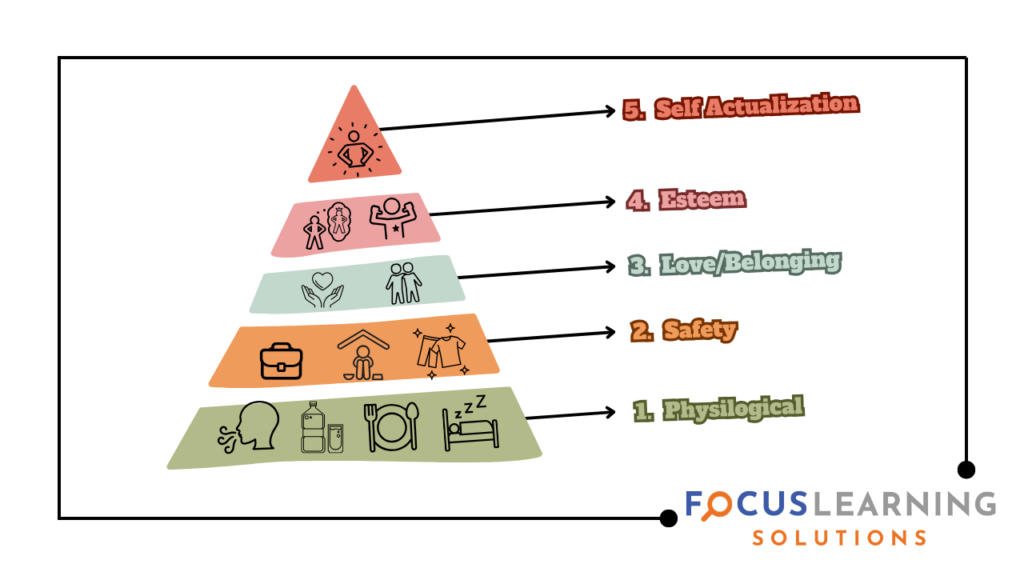
Is Maslow’s Hierarchy of Needs Debunked by modern psychology? Pick up any Organizational Behavior textbook, and almost certainly, one of the first concepts you will see is this famous pyramid.
It is a simple and seemingly logical model: a pyramid with five levels. Starting from the bottom, you move up as each need is supposedly fulfilled:
- Physiological (Food, Water)
- Safety (Shelter, Security)
- Love & Belonging (Community)
- Esteem (Respect)
- Self-Actualization (Purpose)
If I recall how it was presented to me, imagine you crash land on a deserted island. First, you find food. Then, you build a shelter. Once safe, you look for friends. Finally, you work on your passion.
It is so neat that I half-expect an avalanche of comments just for questioning it. But that very simplicity is its weakness.
Why Is Maslow’s Hierarchy of Needs Debunked?
The main reason we see Maslow’s Hierarchy of Needs debunked so often today is the lack of empirical evidence. Abraham Maslow created this framework in 1943 essentially in his head. There were no large-scale surveys, no controlled global experiments, and no “Big Data.” Just his observations of a few “exemplary” individuals.
If he had met my friend Craig V. from Lawrence, Kansas, he might have had to reconsider his entire pyramid. His story is the perfect example of why this theory fails.
The Story of Craig: A Real-Life Anomaly
Craig is a “simple” man—what most would call a hippie. If you know Lawrence, Kansas, that is hardly a surprise. He once told me about a winter ritual where he and his friends would sit in a makeshift hot tub in the freezing Kansas winter, laughing under the stars.
When I asked “All winter?”, he just smiled and said,
“Nothing in the world really mattered. I just wanted to enjoy life and share the moment with people close to me.”
Here is the paradox: Craig was technically homeless, jobless, and unsure where his next meal would come from. According to the theory, he hadn’t fulfilled his first two levels (Physiological & Safety). Yet, he lived with joy and connection.
This contradicts the rigid structure of the pyramid, effectively proving Maslow’s Hierarchy of Needs debunked in this context. Perhaps, in his own way, he had reached Self-Actualization… or at least skipped straight to Love & Belonging.
3 Reasons The Pyramid Model Fails
Life is not a video game where you clear Level 1 to unlock Level 2. People do not live in neat pyramids; they live in contradictions. Here is why the model struggles:
- The Starving Artist: Many creatives sacrifice physiological needs (food/comfort) for self-actualization.
- The Heroic Firefighter: Sacrifices safety for a sense of duty and belonging.
- Cultural Differences: In many Asian cultures, “Belonging” comes before “Self”, unlike in the West.
The pyramid helps us think about human needs, but humans are too complex for five neat boxes. This complexity is the core argument whenever you hear Maslow’s Hierarchy of Needs debunked by modern psychologists.
For more academic context on this critique, you can read about Modern Criticisms of Maslow.
Also, check out our insights on Corporate Training Myths for more debunked theories.
So, the next time you see Maslow’s Pyramid in a training slide, ask yourself: Are we building a life, or just checking boxes?
ملخص: هل هرم ماسلو خاطئ؟
إلى القادة والمفكرين:
نتعلم دائماً أن احتياجات الإنسان مرتبة مثل الهرم. لكن قصة صديقي “كريج” تثبت العكس. هو كان بلا مأوى (فقدان الأمان) لكنه عاش سعيداً (تحقيق الذات).
الحياة ليست لعبة فيديو ننتقل فيها من مستوى لآخر بانتظام. البشر أكثر تعقيداً من ذلك.
Ringkasan: Gugatan Terhadap Teori Maslow
Kita sering diajarkan bahwa perut harus kenyang dulu baru bisa mikirin karya. Itu Salah.
Kisah Craig membuktikan manusia bisa bahagia tanpa harta. Inilah bukti nyata teori piramida Maslow yang terpatahkan (Debunked).